Valle de Bravo
Valle de Bravo's colonial lakeside town, water sports on Lake Avándaro, and monarch butterfly sanctuary nearby. Day trip and weekend guide from Mexico
From Mexico City: Private Tour to Valle de Bravo
Quick facts
- Altitude
- 1,830 m / 6,004 ft
- Currency
- Mexican peso (MXN) — cards accepted in town
- Best for
- Lakeside colonial town, water sports, paragliding, monarch butterfly sanctuary
- Getting there
- 2.5–3 hrs from Mexico City by car; or organised tour
A colonial lake town on a different schedule
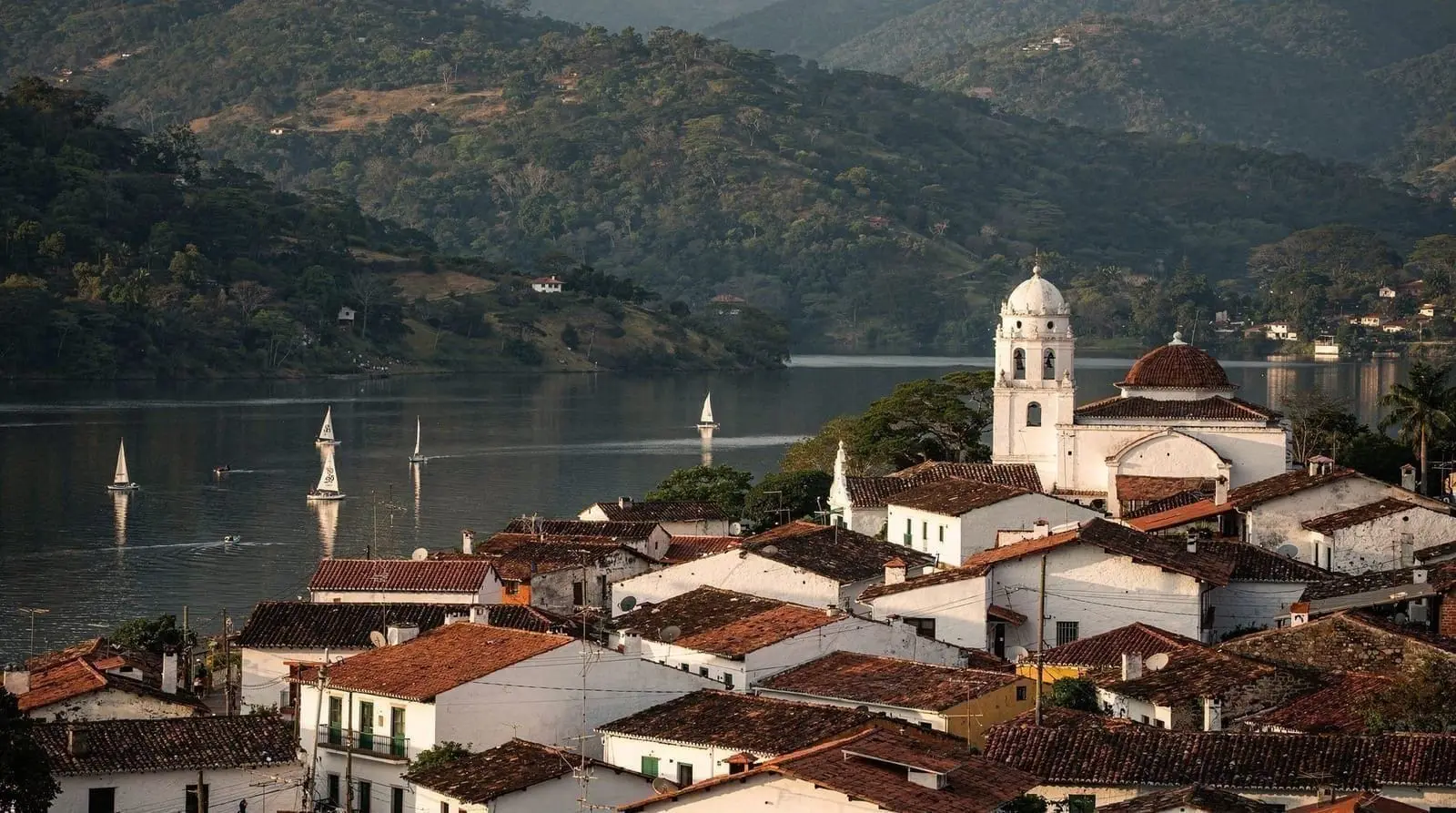
Valle de Bravo is a small colonial town on the shore of Lake Avándaro (technically a reservoir created by the Miguel Alemán dam in 1947) in the state of Mexico, about 160 km west of Mexico City. It is the weekend retreat of Mexico City’s professional middle class — those who can afford the 2.5–3 hour drive or the small plane from the Toluca airport. The town itself is well-maintained, attractive, and functions as a genuine resort destination with water sports, paragliding, good restaurants, and a colonial centro that stays alive after dark.
It is not a backpacker destination and it is not undiscovered. Valle de Bravo is a functioning resort town with corresponding prices — accommodation is more expensive than in Mexico City, restaurants are priced for weekend visitors, and the lake-view boutique hotels charge accordingly. What it offers is a combination of colonial architecture, a genuine lake setting, outdoor activities, and — from November to February — proximity to one of the world’s great natural phenomena: the monarch butterfly overwintering in the Sierra Chincua mountain range nearby.
| Where | State of Mexico, ~160 km / 2.5–3 hrs west of Mexico City |
| Cost | Guesthouses from ~600 MXN/night; boutique lake-view hotels 2,000–5,000 MXN/night |
| Time needed | 1–2 days (weekend stay recommended) |
| Getting there | Car via Toluca toll highway, or organised tour; public bus is indirect |
| Best time | Oct–May for weather; Dec–Jan for peak monarch butterfly density |
The town: colonial centre and the malecón
Valle de Bravo’s historic centre is compact — the Zócalo (Joaquín Arcadio Pagaza plaza), the 16th-century parish church, and the surrounding streets of whitewashed colonial buildings with flower-filled balconies can be walked comfortably in 45 minutes. The town’s character is generally well-preserved; the buildings around the plaza have been maintained at a standard that is above average for Mexican colonial towns of similar size.
The malecón (lakeside promenade) runs along the western edge of town and is where the weekend social life concentrates: families on benches, restaurants with lake-view terraces, boat hire operators, and the view across Lake Avándaro toward the mountains. Sunset over the lake from the malecón is the day’s most atmospheric moment.
The weekend tianguis (market) on Saturday and Sunday mornings near the main plaza sells produce, artisan food products, and handmade crafts from the surrounding Mazahua and Matlazinca indigenous communities. The variety of local cheeses, honeys, and artisan mezcals available here is notably better than what you find at tourist-oriented market stalls.
Lake activities: water sports and paragliding
Lake Avándaro supports a range of water sports: sailing, kayaking, paddleboarding, windsurfing, and motor boat hire are all available from operators on the malecón. Prices vary by activity — a basic two-hour kayak rental runs approximately 200–400 MXN. Sailing school and equipment rental is available for those with prior experience.
Paragliding is the other major activity associated with Valle de Bravo. The thermal conditions above the lake and surrounding hills are considered some of the best in Mexico for paragliding, and international competition events are held here. Tandem paragliding flights (no experience required) depart from a hill above town and last approximately 20–40 minutes. Prices run approximately 1,200–2,000 MXN for a tandem flight. Multiple operators work from the same launch zone.
Monarch butterflies: the sanctuary nearby
The Monarch Butterfly Biosphere Reserve — a UNESCO World Heritage Site — is located in the mountain forests of Michoacán and the State of Mexico, approximately 60–90 minutes from Valle de Bravo. The butterflies arrive from Canada and the US each year in late October–November, overwintering in the oyamel fir forests at altitudes of 2,700–3,500 m before beginning their return flight in March.
The sanctuary most commonly visited from Valle de Bravo is El Rosario or Sierra Chincua. Access involves a 1.5–2 hour drive from Valle de Bravo, then a walk or horse ride into the forest. The butterflies, when present in peak numbers (December–January), cluster so densely on the trees that the branches appear to move — a sight that has no parallel in Mexico for sheer natural density. Temperatures at sanctuary altitude are cold (3–12°C); bring warm layers.
The Valle de Bravo and Monarch Butterfly private tour from Mexico City covers both the town and the sanctuary in a combined day, though this is a long day (10–12 hours). For a proper butterfly visit, staying overnight in Valle de Bravo and visiting the sanctuary early the following morning — when the butterflies are most active — is the better approach.
If the butterflies are your main reason for coming, it helps to read the best time to visit Mexico City guide first: the same November-to-February window that suits the monarchs also tends to be the most comfortable period in the capital, so the two halves of the trip line up well.
Getting there
By car: Mexico City to Valle de Bravo via the Toluca toll highway (Mexico 15) and then Mexico 134 takes approximately 2.5–3 hours. The road from Toluca to Valle de Bravo is a two-lane mountain road with curves — pleasant in daylight, more demanding after dark. Parking in the town centre is available but limited on weekends.
Guided tour: The private Valle de Bravo day tour from Mexico City handles transport and includes time in the town with guidance. This is more practical than the bus option for visitors without a car, as the public transport combination (bus to Toluca, then connecting service to Valle de Bravo) involves multiple steps.
By public bus: This is possible but indirect — buses from Mexico City’s Terminal Poniente (Metro Observatorio) to Toluca, then connecting buses to Valle de Bravo via Zitácuaro or Tejupilco. Total journey takes approximately 3–4 hours with connections. Not practical for a single day; feasible for an overnight trip.
Where to stay
Valle de Bravo’s accommodation ranges from budget guesthouses in the centro (600–1,000 MXN/night) to boutique hotels with lake views (2,000–5,000 MXN/night). The most popular option for Mexico City weekenders are the mid-range hotels on or near the malecón — Hotel Los Arcos and Hotel Loto Azul are consistently reviewed well in the 1,500–2,500 MXN range. Booking is essential on holiday weekends (Christmas, Easter, long weekends) when the town fills entirely.
Without a car, the getting around Mexico City guide explains how to reach the Terminal Poniente and the Observatorio Metro stop, which is where the bus journey begins. Visitors flying into the capital can use the airport to city centre guide to plan the first leg before heading out to the lake.
Practical information
Altitude and climate: At 1,830 m, Valle de Bravo is lower than Mexico City and has a slightly warmer climate. The lake creates a microclimate that moderates temperatures. Summer (June–September) brings rain in the afternoons; the lake can be rough in August storms. The best weather is October through April.
Day trip feasibility: It is feasible as a day trip from Mexico City if you have a car or join an early-departing tour. A day trip provides 4–5 hours in the town after accounting for travel. For the monarch butterfly sanctuary, a day trip from Mexico City is very long (12+ hours total); an overnight in Valle de Bravo with the sanctuary on day two is much more manageable.
The private Valle de Bravo day trip is built for exactly this early-departure day-trip format, since it doesn’t depend on a shared group schedule.
The best day trips from Mexico City guide covers Valle de Bravo alongside Teotihuacán, Tepoztlán, Puebla, and Tolantongo with honest time-cost assessments.
Visitors coming from a higher-altitude base will notice the difference; the Mexico City altitude guide is useful background for anyone who is sensitive to elevation changes on either end of the trip. Travellers still working out how long to spend overall can compare options in the how many days in Mexico City guide before deciding whether a lake weekend fits.
When to visit: month by month
Valle de Bravo has two distinct seasonal draws — the lake town itself and the monarch butterfly sanctuary — and they don’t peak at exactly the same time.
| Period | Weather on the lake | Monarch butterflies | Notes |
|---|---|---|---|
| Nov–Feb | Cool, dry, clear | Present, peaks Dec–Jan | Best overall combined visit |
| Mar–May | Warm, dry | Migrating north by mid-March | Good for lake activities, butterflies fading |
| Jun–Sep | Rainy, afternoon storms | Absent | Lake can be rough; avoid for paragliding |
| Oct | Transitioning to dry | Arriving late Oct/early Nov | Shoulder season, fewer crowds |
For a trip built around both the town and the butterflies, December and January are the sweet spot: dry lake weather and peak butterfly density in the same window. If the butterflies aren’t a priority, October through May all offer reasonable conditions for the lake and water sports, with the rainy months (June–September) best avoided for paragliding and boating.
Comparing Valle de Bravo with other Mexico City nature escapes
| Destination | Distance from CDMX | What it offers | Best for |
|---|---|---|---|
| Valle de Bravo | 2.5–3 hrs | Lake town, water sports, paragliding, monarch butterflies | Colonial-town weekend escape |
| Tolantongo | 3.5–4 hrs | Turquoise thermal pools, cave, canyon | Hot springs, overnight nature trip |
| Xochimilco | ~30–45 min | Canals, trajineras, chinampas | Half-day, no overnight needed |
Valle de Bravo sits in between the other two on distance and effort — closer than Tolantongo but still requiring a proper weekend rather than a rushed day trip to do it justice, especially if the monarch sanctuary is on the list. The Mexico City 7-day itinerary is the natural place to fit a Valle de Bravo weekend without cutting into time in the capital itself.
Other nearby escapes suit different moods. Tepoztlán offers a mountain-village atmosphere rather than a lake, Taxco is the choice for a hillside colonial silver town, and Puebla and Cholula work better for travellers who want churches, food and a bigger city feel. For something much closer to the capital, Teotihuacán fits comfortably into a single day, which Valle de Bravo does not.
Short on time overall? The Mexico City weekend itinerary and the 5-day itinerary show how much of the capital can be covered, which makes it easier to judge whether a lake trip is worth the days it takes from the schedule.
The town’s food and café scene
Valle de Bravo’s restaurant quality reflects its affluent weekend clientele. The waterfront malecón strip has restaurants with lake views at corresponding prices: a typical lunch for two with drinks runs 400–700 MXN. The better value is one street back from the water: several family restaurants on Bocanegra and Santa María Ahuacatlán serve comida corrida (set lunch menus) at 80–120 MXN that are aimed at local workers and are substantially better quality-to-price than the tourist waterfront options.
La Michoacana ice cream shops throughout the centro sell paletas (fruit ice lollies) and helados at 25–35 MXN — the mango-chile and guanábana flavours are local specialities. Fresh tamales from the market on Saturday and Sunday mornings cost 25–40 MXN each; the chaya (a green leafy plant used as a local ingredient in Michoacán cooking) tamales are unusual and worth trying.
For coffee: Café Iberia on Pagaza plaza is the town’s most established café with lake views and reliable espresso. Budget 40–70 MXN for a coffee. The organic market’s coffee vendors on Saturday mornings sell farm-direct coffee from the Veracruz highlands at below-boutique prices.
Frequently asked questions about Valle de Bravo
When can I see the monarch butterflies near Valle de Bravo?
The butterflies typically arrive in late October/early November and are present in peak numbers from December through February. By mid-March, they begin migrating north. The best viewing is December and January when the colonies are at maximum density and the mornings are cold enough that the butterflies cluster together in the trees. By 11:00 as temperatures rise, the butterflies begin flying, creating the most photogenic but also most chaotic conditions.
Is the monarch butterfly sanctuary worth the extra drive from Valle de Bravo?
Yes, for anyone who has not seen the overwintering colony before. The density of monarch butterflies in the oyamel forest during peak season is one of the most remarkable natural spectacles in North America. The drive from Valle de Bravo adds 1.5–2 hours each way; it is manageable as a morning excursion from an overnight stay.
What water sports are available on Lake Avándaro?
Sailing, kayaking, paddleboarding, windsurfing, and motor boat hire from malecón operators. Paragliding from the hill above town. Fishing is also practiced on the lake (bass and trout). Equipment rental and instruction are available for most activities. Prices range from 200 MXN for a basic kayak rental to 2,000 MXN for a tandem paragliding flight.
Is Valle de Bravo expensive compared to Mexico City?
More expensive in accommodation — the resort-town premium is real. Restaurant prices are similar to Roma or Condesa in Mexico City: budget 150–300 MXN for a main course at a mid-range restaurant. Street food and market food near the tianguis are comparable to anywhere in Mexico.
Can I visit Valle de Bravo without a car?
Yes, by public bus (Terminal Poniente to Toluca then connecting to Valle de Bravo, 3–4 hours total) or by joining an organised tour. The town itself is walkable once you arrive. However, reaching the monarch butterfly sanctuary requires private transport — you cannot do it reliably by public transport from Valle de Bravo.
Is Valle de Bravo a good base for multiple day trips?
Reasonably, for the western State of Mexico and parts of Michoacán. The monarch butterfly sanctuary is 60–90 minutes away. Toluca (with the Cosmovitral botanical garden in a former art nouveau market) is 90 minutes northeast. Malinalco (an Aztec cliff-face temple) is 60 km southeast. If you want to cover the western Mexico attractions, Valle de Bravo works as a base for 2–3 nights.
Top experiences
Bookable activities with verified prices and instant confirmation on GetYourGuide.