Frida Kahlo Museum guide: everything you need to know
Mexico City: Frida Kahlo Museum Tour
What do I need to know before visiting the Frida Kahlo Museum?
Book tickets in advance — the museum sells out weeks ahead in peak season. The entrance is 320 MXN (approximately USD 17). Allow 1.5–2.5 hours inside. The collection includes Frida's personal spaces, her studio, the garden, her costumes and jewellery, and a selection of her own artwork. It is a small but exceptional museum best appreciated slowly.
The house that made Frida Kahlo
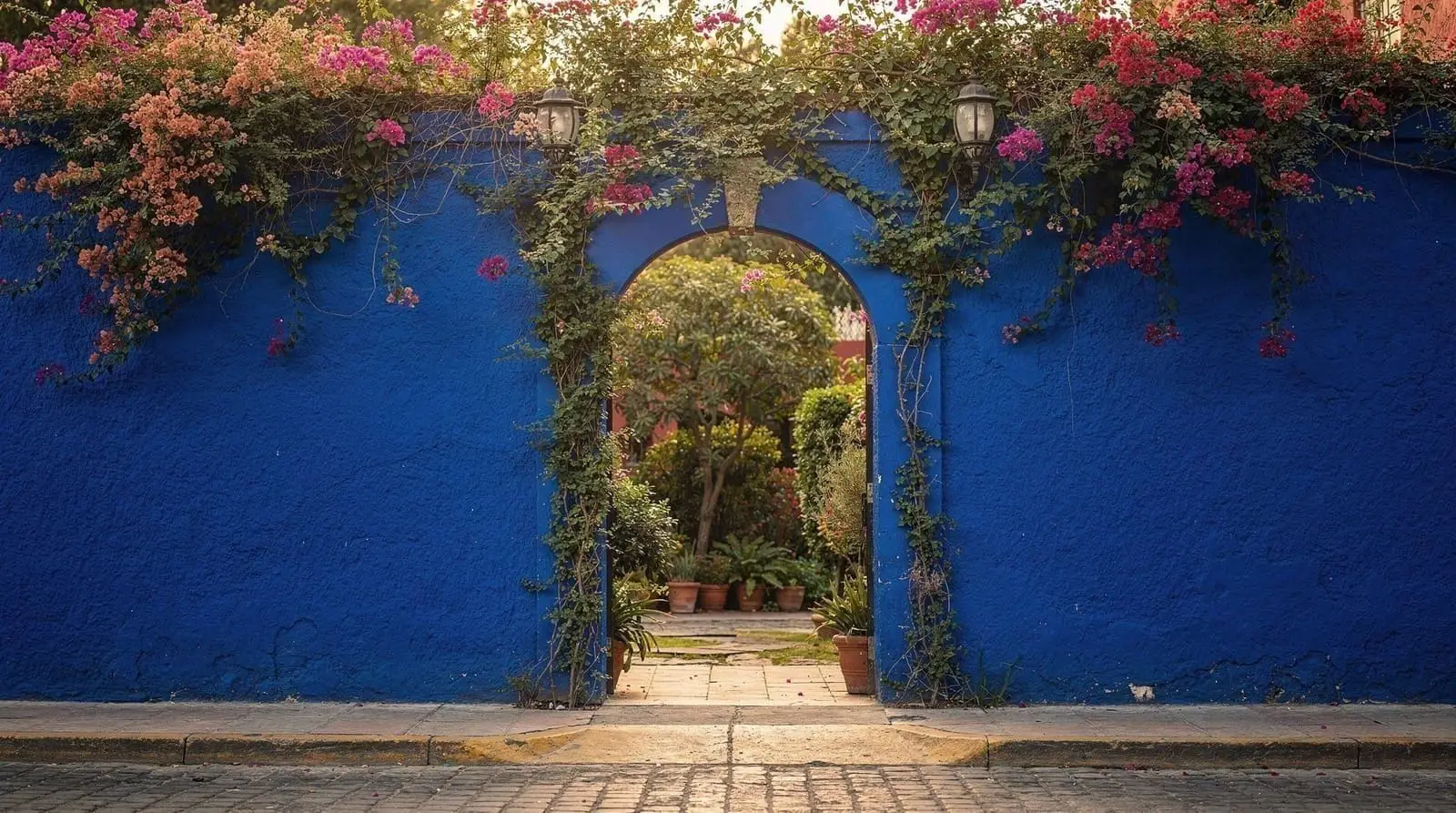
La Casa Azul — The Blue House — sits on a corner in the Coyoacán neighbourhood where Frida Kahlo was born in 1907, lived most of her life, and died in 1954. The deep cobalt blue walls, visible from the street, are one of Mexico City’s most recognisable sights. Inside, every room preserves the physical accumulation of a turbulent, prolific, politically charged life.
The Frida Kahlo Museum is not a conventional art museum in the sense of a gallery with paintings on white walls. It is a biographical space: Frida’s studio with brushes left in place, her corsets (35 operations over her lifetime left her body requiring metal supports that she decorated and painted), her Tehuana dresses from Oaxaca’s Tehuantepec Isthmus that became her chosen identity, letters from Diego Rivera during and after their two marriages, and the kitchen where she entertained artists, intellectuals, and political activists including Leon Trotsky (whose house is 10 minutes away in Coyoacán).
Understanding Frida before you arrive transforms what you experience inside.
| Where | Londres 247, Del Carmen, Coyoacán |
| Cost | 320 MXN (around $17 USD) |
| Time needed | 1.5–2.5 hours |
| Getting there | Uber 25–35 min from Roma/Condesa |
| Booking | 1–4 weeks ahead depending on season |
Frida Kahlo: the essential background
Frida Kahlo was born on July 6, 1907 to a German-Hungarian father (Guillermo Kahlo, a photographer) and a Mexican mother with Indigenous heritage. Her life was defined by two catastrophic events: polio at age 6, which left her right leg thinner and shorter; and a severe bus accident at age 18, which broke her spinal column, collarbone, ribs, pelvis, and right leg in multiple places, and impaled her with a metal handrail.
She was bedridden for months after the accident and began painting during recovery, starting with self-portraits using a mirror rigged above her bed — which is why her bed and the overhead mirror are among the museum’s most moving objects.
Her relationship with muralist Diego Rivera — 20 years older, having been married twice before, politically controversial, artistically dominant — was a partnership of equals in art and extremes in personal life. They married in 1929, divorced in 1939, remarried in 1940. Both had numerous affairs; Frida’s included women as well as men; Diego’s included Frida’s sister Cristina. These relationships are visible throughout the museum in photographs, letters, and dedicated rooms.
Her work — approximately 143 paintings, of which 55 are self-portraits — is explicitly autobiographical. As she said: “I paint myself because I am so often alone and because I am the subject I know best.” Her style is proto-surrealist (though she rejected the label), rooted in Mexican folk art, and deeply personal. The museum contains enough context to understand the imagery.
What to see in the museum
The garden: The vivid blue-walled courtyard with pyramids containing pre-Columbian artifacts, a large Judas paper-maché figure, and the overgrown, jungle-like garden Frida tended. This is the first and last thing you see — allow time at both ends.
The studio: Frida’s painting studio on the upper level has her easel, brushes, and palette preserved as if she just stepped away. An unfinished portrait of Stalin sits on the easel — a reminder of her Communist Party membership and her political commitments. Cases contain her jewellery, medals, and personal collections of folk art objects.
The bedroom: The bed with the overhead mirror. The walls covered with photographs — Diego, her family, Stalin, Chairman Mao, photographs of Frida herself. The corsets displayed in cases nearby. This room is where the scale of physical suffering becomes tangible.
The kitchen and dining room: A traditional Mexican kitchen with clay pots, a wood-fired stove, and the ceramic lettering “Frida y Diego” on the wall. This was a lived space, not a preserved showpiece — it was used for cooking until Frida’s death.
The personal items: Kahlo’s Tehuana dresses, huipiles (embroidered tunics), and jewellery are the physical manifestation of her chosen cultural identity — the clothing of the matriarchal society of the Tehuantepec Isthmus in Oaxaca. Her use of traditional Indigenous dress was explicitly political and explicitly aesthetic simultaneously. Diego Rivera wrote that her way of dressing was a political act.
The artworks: Several of Kahlo’s own paintings are displayed throughout, including “Marxism Will Give Health to the Sick” (her last major completed work) and several intimate still-life and portrait pieces. These are not framed behind rope — they are in the rooms where they were made.
How to book tickets
Official site: museofridakahlo.org.mx — the most direct option, with timed entry slots. The site is in Spanish and English.
Via GetYourGuide: A guided tour that includes museum entry handles the booking for you and adds interpretive value that significantly enhances the visit. Particularly useful for first-time visitors and anyone who wants the biographical context delivered in person.
Entry-only via GetYourGuide: The Frida Kahlo Blue House entry ticket is available for those who prefer to explore independently.
Self-guided option: The Coyoacán self-guided tour with Frida Kahlo Museum tickets combines museum entry with a mapped route through Coyoacán, useful if you want to combine the museum with the neighbourhood in a structured half-day.
Current pricing (2026): 320 MXN (approximately USD 17) for general admission. Tickets are sold online only, in advance.
When to book: March through April (high season): book 3–4 weeks ahead minimum. May through September: 1–2 weeks ahead is typically sufficient. October–November: book 2–3 weeks ahead (Día de Muertos period is popular).
Practical visit information
Address: Londres 247, Del Carmen, Coyoacán, 04100 CDMX
Getting there: Uber from Roma/Condesa takes 25–35 minutes and costs 70–110 MXN. Metro Line 3 to Coyoacán (Viveros station), then 20-minute walk — doable but the Uber is significantly more convenient for this specific destination.
Opening hours: Tuesday and Friday to Sunday 10:00 am – 6:00 pm, Wednesday 11:00 am – 6:00 pm, Thursday 10:00 am – 9:00 pm. Closed Mondays. Check museofridakahlo.org.mx before your visit as special exhibition days may vary.
Group size: The museum limits visitor numbers to protect the building — this is why booking is essential. Self-guided visits operate in timed slots. Guided tours have their own booking quotas.
The museum shop: The official gift shop (separate from the museum entrance) sells licensed reproductions of Frida’s artwork, jewellery inspired by her style, and excellent books including the major critical catalogue of her work. Prices are fair and quality is noticeably higher than the souvenir stalls on the street outside.
Combining the museum with Coyoacán
The Frida Kahlo Museum works best as part of a Coyoacán half-day rather than an isolated visit. See the Coyoacán walking guide for a route that combines the museum with the neighbourhood’s other highlights.
The essential post-museum walk:
- Walk north from the museum to the main plazas (Jardín Hidalgo and Jardín Centenario, 5 minutes)
- Lunch at the Coyoacán Market (Mercado de Antojitos) — the food stalls around the covered market serve excellent affordable comida corrida and antojitos
- Coffee at El Jarocho (Calle Cuauhtémoc) — a legendary traditional café that has been serving excellent café de olla and espresso for decades
- Browse the craft market around the plazas
León Trotsky’s house (Museo Casa de León Trotsky, Calle Viena 45, 10 minutes’ walk from Casa Azul) is the house where the Russian revolutionary lived in exile after Stalin ordered his assassination, and where he was killed with an ice pick in 1940. It is less visited than the Frida Kahlo Museum but a genuinely fascinating companion visit for anyone interested in 20th century political history.
The Diego Rivera Murals guide covers the relationship between Frida and Diego from a mural-focused perspective and adds further context to the Frida museum experience.
Best time of day and season to visit
Opening time (10:00am) on a weekday is consistently the least crowded slot — arriving then means having the studio and bedroom largely to yourself before tour groups and later independent visitors arrive. Weekends, particularly Saturday, see the heaviest traffic between 11am and 2pm; if a weekend visit is unavoidable, book the first available slot of the day. Seasonally, the rainy months (June–August) are quieter than the March–April jacaranda peak, when the museum’s booking calendar fills fastest alongside the rest of Coyoacán’s tourist season. The best time to visit guide covers how this fits the wider seasonal picture for a CDMX trip.
If you only have 45 minutes
The museum’s timed-entry system means you should never be rushed at the door, but some visitors do arrive with a tight schedule before a flight or a connecting activity. In that case, prioritise the studio and the bedroom — these two rooms contain the objects (the easel with the unfinished Stalin portrait, the bed with the overhead mirror) that make the biographical framing click into place. The garden is worth 5 minutes at minimum on the way in or out; skip the kitchen and dining room and the temporary exhibition space if genuinely pressed for time. A 45-minute visit is a compromise, not the recommended pace — most visitors regret rushing this particular museum more than almost any other in the city.
Frida Kahlo in the rest of Mexico City
Frida Kahlo’s life beyond Coyoacán is visible across the city:
National Palace murals: Diego Rivera’s epic mural cycle in the National Palace on the Zócalo includes several depictions of Frida. See the Zócalo and Templo Mayor guide for the Palace context.
Palacio de Bellas Artes: Frida Kahlo and Diego Rivera’s work is connected to the Bellas Artes institutionally and historically. See the Palacio de Bellas Artes guide.
Anahuacalli Museum: Diego Rivera built this extraordinary pyramid-shaped museum in Coyoacán to house his pre-Columbian art collection. Less visited than Casa Azul but architecturally stunning and thematically related.
Fitting the museum into your wider trip
The museum sits in the south of the city, so it helps to decide early where you will sleep. Our where to stay in Mexico City guide compares the neighbourhoods that make the trip to Coyoacán easiest, and the Roma and Condesa area is a popular base for travellers who want to combine café-hopping with a morning at Casa Azul.
For the journey itself, the getting around Mexico City guide explains the options between the centre and Coyoacán, so you can arrive relaxed for your timed slot rather than watching the clock in traffic.
If this is your first visit to the capital, the 3-day Mexico City itinerary shows where a Frida morning slots in alongside the historic centre and the major museums. Pair it with the Mexico City street food guide for ideas on what to eat once you leave the house and head back into the neighbourhood’s streets.
Photography and etiquette inside the house
Personal photography (phone or camera, no tripod) is permitted in most rooms, including the garden and the studio, but flash is prohibited everywhere to protect the paintings and period objects. Some specific pieces and the bedroom’s more fragile items may carry additional restrictions marked by signage — follow staff guidance rather than assuming blanket permission.
Because this is a biographical house rather than a gallery, other visitors are often moving slowly and reading labels closely; the studio and bedroom in particular reward patience rather than pushing past people for a clear shot. Given the museum’s timed-entry caps on visitor numbers, the crowding is rarely as bad as an untimed museum of similar popularity, but the popular rooms still bottleneck around 11am–1pm on weekends.
Frequently asked questions about the Frida Kahlo Museum
Is the Frida Kahlo Museum worth the money?
320 MXN (approximately USD 17) is fair value for one of Mexico’s most significant and well-maintained house museums. The experience is qualitatively different from a standard gallery — the biographical depth and the physical spaces make it more emotionally resonant than looking at paintings in white rooms. Most visitors consider it a highlight of their Mexico City trip.
Is the Frida Kahlo Museum crowded?
Yes, during peak hours (11:00 am – 2:00 pm on weekends and in March–April). Visiting at opening time (10:00 am on weekdays) significantly reduces crowding. The museum’s timed entry system controls overall numbers, but within the house, the most popular rooms (studio, bedroom) can feel crowded mid-morning on a Saturday.
Are children allowed at the Frida Kahlo Museum?
Yes. The museum is suitable for older children (10+) who have some context about Frida’s life. For younger children, the garden is the most accessible element and the visual richness of the house is genuinely engaging even without biographical understanding.
How does the Frida Kahlo Museum compare to reading about Frida?
The physical space adds something that books and documentaries cannot provide — the scale of the house, the specific quality of the afternoon light through the studio windows, the weight and texture of the objects, the smell of paint in the studio. Reading Hayden Herrera’s biography before visiting is genuinely the best preparation — the objects in the museum come alive with that context.
Is the Mexico City Frida Kahlo experience connected to any tours?
Yes. The Frida Kahlo Museum guided tour with options is a semi-private format that keeps group sizes small and provides a knowledgeable guide through the collection. It is the recommended format for visitors who want substantive interpretation rather than a self-guided walk-through.
How do I buy tickets to the Frida Kahlo Museum?
Tickets can be purchased online at museofridakahlo.org.mx (the official site) or through authorised booking platforms. In peak season (March–April, weekends, holidays), tickets sell out 2–4 weeks ahead. Walk-up tickets are occasionally available but cannot be relied upon. Book at minimum 1–2 weeks ahead outside peak season, 3–4 weeks ahead in spring.
How long does it take to visit the Frida Kahlo Museum?
Most visitors spend 1.5–2 hours. Frida scholars and art enthusiasts often take 2.5–3 hours. The house is not large — the depth of the visit depends on how much time you give each room. Do not rush through; the collection rewards careful attention to the personal objects as much as the artwork.
Is photography allowed inside the Frida Kahlo Museum?
Photography is permitted in most areas of the Casa Azul, including the garden and most rooms. Some specific artworks and the bedroom areas may have restrictions — follow signage and staff guidance. Flash photography is not allowed anywhere inside the museum.
Is a guided tour worth it at the Frida Kahlo Museum?
A good guide adds significant value by providing biographical context that brings the objects to life. Frida’s life — her relationship with Diego Rivera, her medical history, her political commitments, her self-constructed identity through clothing and jewellery — is the interpretive lens for everything in the house. Without context, it is a beautifully preserved house; with it, it is extraordinary.
What is the Frida Kahlo Museum actually about?
La Casa Azul (The Blue House) was Frida Kahlo’s childhood home and the house where she died in 1954. After her death, Diego Rivera donated it to the Mexican state as a public museum. It opened in 1958. The collection includes Frida’s personal belongings, her studio with unfinished works, her traditional Tehuantepec dresses and jewellery, her correspondence, medical apparatus (she had 35 operations in her lifetime), and a selection of her self-portraits and other paintings.
Are there Frida Kahlo original paintings in the museum?
Yes. The museum holds a selection of Kahlo’s own works including several self-portraits and personal pieces. However, the majority of her major paintings are in collections worldwide (MoMA, Tate Modern, private collections). The house itself and her personal objects — costumes, medical corsets, jewellery, photographs, letters — are in many ways more revelatory than additional paintings would be.
Top experiences
Bookable activities with verified prices and instant confirmation on GetYourGuide.