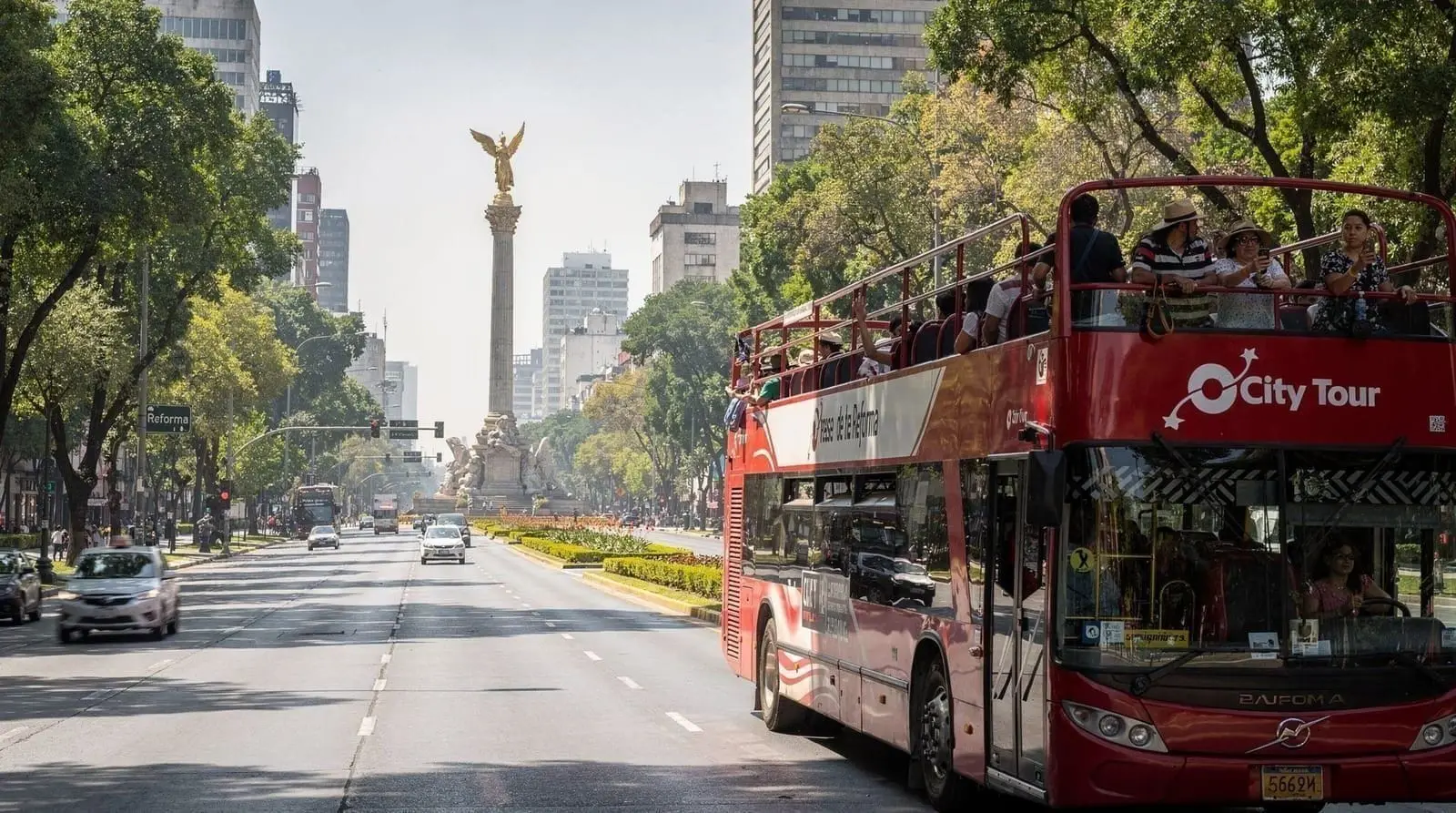
Mexico City hop-on hop-off bus guide: routes, stops and honest value assessment
Mexico City: Hop-on Hop-off City Tour by Turibus 1-Day Pass
Is the hop-on hop-off bus in Mexico City worth the price?
For first-time visitors covering multiple neighborhoods in 1–2 days, the Turibus (main HOHO operator) offers a practical orientation tool at 250–450 MXN per day. For visitors comfortable with the Metro and Uber, it's mostly redundant. The best use case: the first day in CDMX to understand the city's geography before using cheaper transport independently.
| Cost | 250–450 MXN/day (1-day and 2-day passes) |
| Best use | Orientation on day one, not all-trip transport |
| Routes | 3 (Centro/Reforma, Polanco/Bosque, Sur) |
| Doesn’t cover | Roma, Condesa, Tepito, Doctores |
| Compare to | Metro 7 MXN/ride, Uber 60–150 MXN/ride |
What the hop-on hop-off bus does well
Mexico City is large — 1,485 km² — and its tourist attractions are genuinely spread across multiple distinct neighborhoods separated by 4–10 km. The Centro Histórico, Roma and Condesa, Polanco, Chapultepec, Coyoacán, and Xochimilco each require separate transport connections that are not always obvious to first-time visitors. The Metro covers most areas but requires map reading and confidence with Spanish-language signage. Uber is easy but adds up over a multi-neighborhood day.
The hop-on hop-off bus — primarily operated by Turibus in Mexico City — addresses this specific navigation challenge: it creates a single-ticket service that connects the main tourist zones, runs on a predictable schedule, and includes an audio guide explaining what you’re passing. The open top deck gives a genuine above-street perspective on Paseo de la Reforma, the Chapultepec Park tree canopy, and the historic center street layout. Booking the hop-on hop-off bus city tour online in advance skips the ticket line at the Zócalo stop, which matters on the busiest mornings.
The honest qualification: Mexico City’s traffic is legendary. The Turibus is a bus in Mexico City traffic. On Reforma or in the Centro Histórico at peak hours, the bus moves slowly. Uber and the Metro are faster between specific points. The value is not speed — it’s orientation.
Turibus routes and what they cover
The Turibus 1-day pass covers all three main routes:
Route 1 — Centro y Reforma (Green route): The main urban tourism spine: Zócalo, Bellas Artes, Alameda Central, Torre Latinoamericana, Paseo de la Reforma, Ángel de la Independencia monument, Zona Rosa, Chapultepec park entrance, Auditorio Nacional. This is the most useful route for first-timers — it covers the historic center and the city’s principal boulevard in sequence.
Route 2 — Polanco y Bosque (Blue route): Polanco’s shopping and restaurant district, Chapultepec park sections 1 and 2, the Anthropology Museum stop, and the Chapultepec Castle access road. This connects naturally to the green route at the park entrance and extends into the upscale Polanco neighborhood.
Route 3 — Sur (Red route): The south route to Coyoacán and, in some configurations, Xochimilco. This is the longest and most traffic-dependent route. Travel time from the center to Coyoacán by bus can be 60–90 minutes in traffic; Uber covers it in 35–50 minutes. The bus makes sense for the journey if you want the above-street views; Uber makes more sense if you’re on a schedule.
What the routes don’t cover
The Turibus does not serve Roma or Condesa directly (the main hipster/foodie neighborhoods where many visitors stay). Reaching Roma from the bus requires getting off on Reforma and walking or taking a short Uber. If you are still choosing a base, the Roma and Condesa neighborhood guide and the Roma vs Condesa comparison explain what you gain by staying outside the bus corridor.
The bus also does not serve Tepito, Doctores, or any of the areas outside the established tourist corridors. This is appropriate — the service is designed for tourist zone navigation.
The night tour
The Turibus Night Tour is a separate fixed product from the hop-on hop-off passes. Departing from the Zócalo in the evening (typically 20:00–22:00), it runs a 90-120 minute circuit of Mexico City’s illuminated nighttime city center.
Mexico City at night is worth experiencing from the open top of a double-decker bus. The historic center buildings lit against the sky, the Ángel de la Independencia monument at night, and Reforma at dusk are genuinely photogenic. The double-decker bus night tour is one of the more useful evening options for visitors who want a panoramic introduction to the city’s nighttime appearance without committing to a specific neighborhood.
Note: this is a fixed guided experience, not a hop-on hop-off service. You board at the Zócalo and ride the full circuit; there are no stops where you disembark.
1-day vs. 2-day passes
The 2-day Turibus pass costs about 50–80 MXN more than a 1-day pass. The calculus for a 2-day pass:
- You’re using the bus for geographic orientation on day 1 and then hopping off at specific attractions on day 2
- Your hotel is near a Turibus stop, making it easy to join the bus
- You’re covering three or more distinct neighborhoods in CDMX over two days
For visitors spending 3+ days in Mexico City and using the Metro and rideshare for most transport, the 1-day pass as an orientation tool on day one is usually sufficient.
Bus vs. other sightseeing options
Several alternatives to the hop-on hop-off bus offer a different quality of city overview:
Bike tours: Multiple operators run cycling tours of the city, covering Roma, Condesa, Centro Histórico and Reforma. A Mexico City bicycle tour gives street-level access to neighborhoods the bus passes above. Better exercise, slower pace, more cultural access. Weather dependent.
Walking tours: Free walking tours (tip-based) run from the Zócalo multiple times daily in English. Better cultural depth than the bus audio guide; slower geographic coverage.
Observation deck: The Torre Latinoamericana (Latin American Tower) at the intersection of Eje Central and Juárez has an observation deck (about 85 MXN) with a 360-degree city view from floor 44. Better for city geography orientation than moving through it.
Is the Turibus worth it for specific traveller types?
First-time Mexico City visitor, 3-day trip: Yes — use it on day one as an orientation tool. Take the green route (Zócalo to Chapultepec) with the audio guide to understand the spatial relationship between the major sites. Then use Metro and Uber for days two and three.
Repeat visitor who knows the city layout: No — you know where things are and transit is more efficient.
Families with young children: The open-top bus is excellent for children who enjoy height, movement and views. The bus keeps the group together without Metro navigation. The Mexico City with kids guide recommends the bus specifically for families managing the city’s scale.
Budget traveller: Skip it — the Metro and Metrobús serve the same routes at a fraction of the cost. Combine with occasional Uber for less central stops.
Visitor with limited mobility: The Turibus has accessible boarding options at main stops. Call ahead to confirm accessibility features at specific pickup points.
Booking and practical details
The Turibus main stop is at the Zócalo (east side, near the entrance to the Centro Histórico). Tickets can be bought at the stop or online in advance.
Schedule: Buses run approximately every 30–45 minutes on each route from approximately 09:00 to 21:00. The last north route bus is typically earlier (check at the stop). The schedule is available on the Turibus app.
Audio guide: Available in English, Spanish, French, Portuguese, German, Italian and Mandarin on all main routes. Headphones provided or use your own.
Weather: The open top deck is exposed. In rainy season (June–October) afternoon showers are common; the lower enclosed deck continues operating. Bring a rain jacket.
Discounts: Children (typically under 5) often ride free or at a reduced rate; check current age brackets at the point of purchase, as they change periodically. Seniors and some student categories may qualify for discounted tickets with valid ID. These discounts are modest but worth asking about, especially for families buying multiple tickets across a 2-day pass.
Photography note: The open top deck gives an unobstructed angle on Reforma’s monument roundabouts and the historic center rooftops that is genuinely hard to replicate from ground level. If photography is a priority, sit on the upper deck’s right-hand side heading toward Chapultepec for the best light in the morning.
Frequently asked questions about Mexico City hop-on hop-off buses
Can I use the Turibus to get to Chapultepec Castle?
Yes. The green route stops at the main Chapultepec Park entrance. From the stop, walk into the park toward the castle hill (20–25 minutes to the castle from the park entrance). The bus does not drive inside the park to the castle gate.
Does the Turibus go to Xochimilco?
The south route includes Xochimilco (or a stop near it) on some schedules. However, the journey from central Mexico City to Xochimilco by bus in traffic is 60–90 minutes. For Xochimilco specifically, a direct Uber or the Metro + tram combination is faster and more reliable. The complete Xochimilco guide covers how to plan that outing on its own.
How often do the buses come?
Typically every 30–45 minutes on major routes during the day. If you miss a bus, the wait is manageable but not minimal. The Turibus app shows real-time bus location on some routes.
Is the audio guide good?
Decent at best. It covers the main landmarks and their history competently. It does not provide the depth of a live guide. The audio guide for the Centro/Reforma route is better than the south route. For visitors who specifically want narrative depth about what they’re seeing, an organized walking or bus tour with a live guide is a better investment.
Can I buy the Turibus pass at the Zócalo without booking online?
Yes, tickets are available at the main Zócalo departure stop on the day. Online booking is useful if you want to guarantee a specific departure time or want to skip the ticket queue on busy days.
What is the Turibus in Mexico City?
Turibus is Mexico City’s main hop-on hop-off double-decker bus service, operated by ADO Group. It runs multiple routes covering the main tourist areas — Centro Histórico, Reforma, Polanco, Chapultepec, Coyoacán and Xochimilco. A 1-day pass costs approximately 250–300 MXN; a 2-day pass approximately 400–450 MXN. The bus has an open top deck with audio guide in multiple languages.
How many Turibus routes are there?
Turibus operates three main routes: the Reforma-Centro route (covering the historic center, Paseo de la Reforma, and Chapultepec), the Polanco-Bosque route (Polanco, Chapultepec, Lomas de Chapultepec), and the South route (Coyoacán, Xochimilco). A combined ticket covers all three. The routes do not perfectly connect all tourist neighborhoods.
What is the Turibus night tour?
The Turibus Night Tour departs from the Zócalo in the evening for a 2-hour circuit of the illuminated historic center, Reforma and Polanco neighborhoods. Cost: approximately 200–300 MXN. This is a fixed guided experience, not a hop-on hop-off service. Mexico City at night, seen from the open top of a double-decker, is genuinely impressive — this is one of the more popular evening options.
Are there other hop-on hop-off operators besides Turibus?
Several small operators offer alternatives, some at lower prices. Quality varies significantly. The Turibus brand, as the ADO Group product, has the most established schedule consistency, cleaner buses and more reliable audio guides. Budget alternatives exist but have worse reviews for punctuality and audio quality.
What stops does the Turibus serve?
Key stops include: Zócalo (starting point), Bellas Artes, Alameda, Paseo de la Reforma, Ángel de la Independencia, Museo de Antropología, Chapultepec Park, Polanco, Auditorio Nacional, Pedregal (south route), Coyoacán, and Xochimilco. Exact stops and frequencies vary by route; check the current schedule on the Turibus website or at the main stop on the Zócalo.
Is the Turibus worth it vs. the Metro?
The Metro at 7 MXN per ride covers most of the same territory more quickly. Uber/DiDi costs 60–150 MXN per ride. The Turibus costs 250+ MXN per day but includes the open-top orientation experience and the audio guide. The calculus favors the Turibus only if you value the geographic orientation, the audio interpretation, and the ability to stop at any attraction without rebooking transport.
How to use the Turibus as a city orientation tool
The most effective use of the hop-on hop-off bus is as a geographic orientation tool on your first full day in Mexico City. Here is a specific strategy:
Morning: Green route (Reforma-Centro) Board at the Zócalo stop and ride the full loop without hopping off. This takes approximately 1.5–2 hours in normal traffic. The audio guide runs continuously. You get a clear sense of the spatial relationship between:
- The historic center (dense, low-rise, colonial)
- Paseo de la Reforma (the wide diagonal boulevard, office towers, monuments)
- The Ángel de la Independencia (the 45 m column at Reforma’s midpoint, Mexico’s national celebration point)
- Zona Rosa (nightlife and hotel corridor south of Reforma)
- Chapultepec Park entrance (where the city’s green lung begins)
After this loop, you have a mental map of the corridor from Centro to Chapultepec that significantly improves navigation for the rest of your trip.
Afternoon: Hop off at Chapultepec Get off at the Chapultepec stop and walk into the park. This could be the Anthropology Museum (see the anthropology museum guide) or the Chapultepec Castle — both are within the park. Take a rideshare back to your hotel from the park. If you would rather spend the second half of the day in the historic core, the Zócalo and Templo Mayor guide pairs well with the morning loop, since the bus starts and ends right there. For a fuller plan around the bus day, see the 3-day Mexico City itinerary.
This approach — one full loop without stops, then selective hopping — maximizes the orientation value while not trapping you in a slow bus for your entire first day.
Turibus vs. the city’s free cultural Sunday
Mexico City runs a program called Muévete en Bici (Move by Bike) on Sundays, closing Paseo de la Reforma to cars from 08:00 to 14:00. Thousands of cyclists, rollerbladers, and pedestrians fill the boulevard. The Turibus runs on alternate routes during this period.
If you’re visiting on a Sunday morning, cycling or walking on a car-free Reforma from the historic center to Chapultepec is a dramatically better experience than the bus. Bike rental stations and available bikes concentrate along Reforma for the Sunday closure. This is free and one of Mexico City’s best urban experiences.
What Paseo de la Reforma looks like from the top deck
One of the Turibus route’s most effective sections is the Reforma corridor itself — the 12-lane diagonal boulevard that runs from the historic center to the Bosque de Chapultepec. Seen from the open top deck of a double-decker, the boulevard reads clearly: the monument roundabouts (Ángel de la Independencia, Diana Cazadora, Cuauhtémoc), the mix of late 19th century Porfiriato buildings and contemporary glass towers, the wide pedestrian median with shade trees.
The Turibus moves slowly enough on this corridor (traffic is usually moderate) to register the architectural sequence. It is arguably the best way to see Reforma as a complete piece of urban planning rather than a succession of intersections at ground level.
Compare this to the same corridor from ground level, walking or in an Uber: at street level, the monuments arrive one at a time and the connecting fabric between them — the exact building styles, the shift from Porfiriato-era stone to 1990s glass — is easy to miss because your attention is on crossing traffic and reading street signs. From the open top deck, that same fabric reads as a single continuous timeline of the city’s architectural history, which is the strongest single argument for taking the bus at least once.
The getting around Mexico City guide and where to stay guide both use the Reforma corridor as the geographic backbone of Mexico City navigation — the bus makes this axis tangible in a way that a map does not.
Turibus and the Turicard pass
An alternative to the basic hop-on hop-off pass is the Turicard 40+ attractions pass — a multi-day pass that includes not just bus access but discounted or free entry to 40+ partner attractions across Mexico City. The partner list includes some museums, observation decks, and cultural venues.
Value analysis: the Turicard is worth its premium price only if you specifically plan to visit multiple partner venues. The entry discounts are real but modest (10–20% in most cases). If you’re visiting the Anthropology Museum (which has its own entry system and Sunday free days for nationals), Chapultepec Castle, and Bellas Artes — all independently priced — the Turicard may save 100–200 MXN over a 3-day visit. Run the specific numbers against your planned itinerary before buying.
Comparing your city-orientation options
| Option | Cost | Speed | Best for |
|---|---|---|---|
| Turibus 1-day pass | 250–300 MXN | Slow (traffic-bound) | First-day orientation, audio guide, open-top views |
| Turibus 2-day / Turicard | 400–450 MXN+ | Slow | Multi-day sightseeing plus attraction discounts |
| Metro | 7 MXN/ride | Fast between stations | Budget travellers comfortable with signage |
| Uber/DiDi | 60–150 MXN/ride | Fastest point-to-point | Families, luggage, tight schedules |
| Bike tour | Varies, guided | Moderate | Street-level access, exercise, weather-permitting |
| Walking tour | Tip-based | Slow, on foot | Cultural depth in Centro Histórico |
None of these is objectively “best” — they solve different problems. The Turibus solves orientation and above-street views; Uber and the Metro solve point-to-point speed; walking and biking solve depth. Most efficient first-time trips combine the bus on day one with the Metro or Uber afterward, as covered in the getting around Mexico City guide.
Accessibility and practical caveats
Wheelchair users and travellers with limited mobility should call ahead to confirm which stops have step-free boarding — not all Turibus stops are equally accessible, and older double-decker units have narrower stairwells to the open top deck than newer ones. Prams and strollers are permitted on the lower deck but are awkward on the open-top stairs; if you’re travelling with a stroller, plan to fold it for boarding.
Payment is by card or cash at the main Zócalo stop, and increasingly by app pre-purchase, which is worth doing in high season (Easter week, Día de Muertos, December) to avoid a queue. Bring sun protection for the open top deck — Mexico City’s altitude means stronger UV exposure than the temperature alone suggests, even on a cloudy-feeling day.
Top experiences
Bookable activities with verified prices and instant confirmation on GetYourGuide.