Soumaya Museum guide: free entry, Rodin sculptures and Mexico's Rockefeller collection
Mexico City: Soumaya Museum, The Greatness of Mexican & Western Art
Is the Soumaya Museum worth visiting and how much does it cost?
Museo Soumaya is free to enter and holds one of the most significant private art collections in the Americas — including the largest Rodin sculpture collection outside France. It's worth 2–2.5 hours. The unmissable sections are the top-floor European paintings, the Rodin hall, and the pre-Columbian objects. Located in Polanco, open daily 10:30–18:30.
A museum you won’t expect
The Museo Soumaya in Polanco should not work as well as it does. A private collection assembled by one of the world’s wealthiest men, housed in an architectural spectacle designed by his son-in-law, filled with art from five continents and three millennia and presented free to the public — it sounds like vanity philanthropy. It is, partially. But the collection is genuinely extraordinary, the building is genuinely interesting, and the combination of a world-class Rodin collection with pre-Columbian artifacts and European paintings creates an experience unlike anything else in Mexico City.
| Where | Plaza Carso, Nuevo Polanco |
| Cost | Free |
| Time needed | 90 min (focused) to 2.5 hrs (all six floors) |
| Getting there | Metro Line 7 to Polanco + 20-min walk, or rideshare |
| Best time | Weekday mornings for a near-empty Rodin hall |
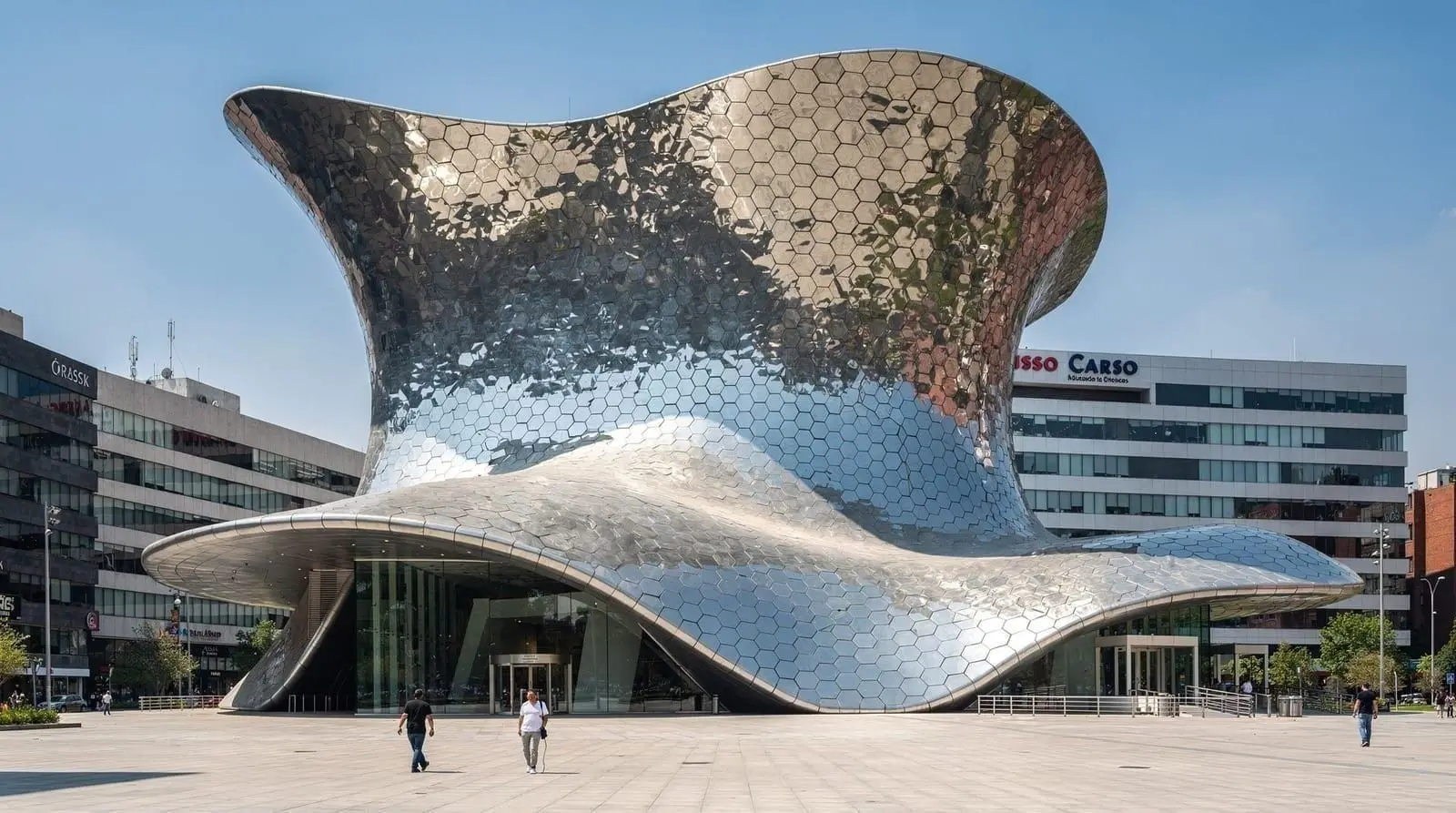
The building itself is worth noting before you enter. Designed by Fernando Romero and completed in 2011, the exterior is clad in 16,000 hexagonal aluminum discs that give it an organic, cellular appearance. The shape — irregular, bulging at the top — is structurally audacious: six irregular steel columns support the entire structure, and no two floors are the same diameter. The interior has no straight walls. The overall effect is deliberately designed to look nothing like a conventional museum.
Location and getting there
Soumaya is in the Plaza Carso complex, in the Nuevo Polanco area of Mexico City. This is about 2 km north of the main Polanco neighborhood around Presidente Masaryk, in a mixed retail and residential development built in the early 2010s.
Metro: Line 7 (orange line) to Polanco station, then either a 20-minute walk or a short rideshare (30–50 MXN).
Uber/DiDi: “Museo Soumaya, Plaza Carso” — approximately 80–120 MXN from Roma or Condesa.
On foot from Chapultepec/Anthropology Museum: Not practical (4+ km). Take a rideshare.
Parking: The Plaza Carso complex has underground parking (paid hourly).
Hours: Daily 10:30–18:30. No reservations required; entry is completely free and walk-in.
Floor-by-floor guide
The museum has six floors organized from the collection’s oldest objects at the base to the most recent at the top. There are no enforced viewing routes; take the elevator to the top and work down, which many visitors find preferable.
Floor 1 — Pre-Columbian collection: The base floor holds Mesoamerican and South American archaeological objects: ceramic figures from the Colima, Jalisco and Nayarit shaft tomb traditions, Aztec stonework, Maya ceramics, and objects from cultures as far south as the Andes. The collection does not have the depth or scholarly presentation of the Anthropology Museum, but selected objects are of significant quality.
Floor 2 — Colonial Mexican art: Spanish colonial religious art from the 16th through 18th centuries: painted retablos (altar pieces), ivory crucifixes, santos (devotional sculptures), ceramic tiles and gilded colonial furniture. A section covers colonial coins from the Mexico City mint, which was the largest silver mint in the colonial world.
Floor 3 — 19th century European and Mexican art: European academic painting from the 1800s, with some well-known works by Alma-Tadema, Bouguereau and their contemporaries. Also includes 19th century Mexican history paintings and Academicism. Less essential for most visitors; worth a quick circuit.
Floor 4 — Rodin and European sculpture: The centerpiece of the museum. Approximately 380 Rodin bronzes and plasters are displayed in the main hall, making this the largest Rodin collection outside the Musée Rodin in Paris. Major works present include multiple authorized casts of The Thinker, The Kiss, The Burghers of Calais, The Age of Bronze, and a large selection of original plasters and maquettes from The Gates of Hell project.
The quality of presentation is high — works are lit and spaced to allow close examination. You can get within arm’s reach of pieces that would be behind barriers elsewhere. This is not reproductions; these are authorized foundry casts or original works from Rodin’s studio.
Also on this floor: other 19th century European sculpture and a small collection of Dalí works including The Persistence of Memory (print) and several bronze sculptures.
Floor 5 — 19th and 20th century European paintings: The strongest floor for recognizable works: a Monet, Renoir, Corot, Pissarro and other Impressionists alongside Dutch and Flemish Old Masters (Murillo, Tintoretto, a work attributed to El Greco). The collection represents acquisitions across different periods and reflects Carlos Slim’s eclectic acquisition strategy rather than a focused art historical program. The result is surprising — you turn a corner and find a painting you know from textbooks.
Floor 6 (top) — Open terrace and skylights: The top floor opens to the signature curved ceiling of the building, which provides natural zenithal light for a main gallery display. Views from the terrace look over Polanco and the surrounding area.
How long to visit
A thorough visit covering all six floors takes 2–2.5 hours. A focused visit (Rodin hall plus top floor paintings) can be done in 90 minutes. There is no café inside the museum, though Plaza Carso has multiple restaurant options.
Recommended sequence: Elevator to top floor, work down. The Rodin hall (Floor 4) is the priority for most international visitors.
Soumaya vs. Jumex (the other Polanco contemporary art museum)
The Soumaya Museum shares the Plaza Carso complex with the Museo Jumex, a contemporary art institution funded by the Jumex juice company’s foundation. The two museums are architecturally adjacent and have very different collections:
- Soumaya: Historical; 30 centuries; pre-Columbian through early 20th century; free
- Jumex: Contemporary; international artists; changing exhibitions; paid entry (approximately 120 MXN)
Both can be visited in the same 3–4 hour block. For visitors interested in contemporary international art alongside the historical collection, the combination is worthwhile.
The guided tour option
The guided tour of Soumaya’s greatest artworks provides an English-language or Spanish-language guided route through the key pieces — useful for visitors who want interpretation of the Rodin collection and the pre-Columbian objects in context.
Official museum staff provide free brief orientation tours at certain hours (check at the entrance); these cover the highlights in 45 minutes.
Combining with the rest of Polanco
The Polanco neighborhood — particularly Presidente Masaryk and its side streets — is Mexico City’s most upscale shopping and restaurant district. The Chapultepec and Polanco destination page covers the neighborhood. Combining a Soumaya visit with lunch or dinner in Polanco works well:
- El Bajío (Presidente Masaryk) — traditional Mexican cooking, justifiably famous
- Quintonil (Newton 55) — fine dining, vegetables-forward, consistently ranked among Mexico’s best
- Mercado de Michoacán (Polanco neighborhood market) — casual, local, cheaper
For a Chapultepec and museums day, a logical route is: Anthropology Museum (morning) → Soumaya Museum (afternoon, with a rideshare between them) → Polanco dinner. The Mexico City 4-day itinerary maps this combination explicitly.
What makes Soumaya unusual as a museum
Most major private collections become museums only after the collector’s death, under terms set by a foundation. The Soumaya is unusual in that Carlos Slim actively managed the collection’s development and the museum’s construction during his lifetime, making deliberate aesthetic and architectural choices — including the unconventional building — as part of a larger cultural project.
The museum is entirely non-commercial: no entry charge, no premium access tiers, no café (the plaza has those). The implicit social contract is straightforward — Slim’s foundation maintains a world-class art collection and building, accessible free to anyone who walks in. Funding comes from the Carso Foundation’s endowment from Slim’s business interests.
This context affects how you experience the building. It is not a hushed institutional space with art-world pretensions. Families with children, school groups, Mexican tourists and international visitors move through the same galleries. The Rodin hall on a Saturday afternoon may have a children’s school group examining The Thinker at close range alongside serious art travellers from Europe. This is either irritating or refreshing depending on your perspective.
The building as artwork
The architectural experience of Museo Soumaya is worth independent attention. Fernando Romero’s design is not conventional museum architecture — it creates no clear internal orientation (floors are circular rings of different diameters, no straight walls), the natural light comes from above rather than the sides, and the floor transition between levels requires the elevator because the circular geometry doesn’t accommodate conventional stair design in the main space.
The exterior hexagonal aluminum tiles catch the sun at different angles throughout the day. The building is most visually striking at midday when the aluminum reflects maximum light, and in late afternoon when the warm light creates a golden tone on the curved west face. Photographing it from the adjacent open plaza space gives the best angle — the building needs distance to be understood as a form.
Soumaya vs. other Mexico City art museums
Mexico City has more museum density per square kilometer than most cities of comparable size, reflecting a century of government cultural investment and significant private philanthropy. How Soumaya sits among them:
- Anthropology Museum (Chapultepec): Pre-Columbian archaeology, no European art, admission fee. The definitive pre-Columbian experience.
- Templo Mayor Museum (Centro): Deep focus on one Aztec site, outstanding. Admission fee.
- Bellas Artes galleries: 20th century Mexican muralism, significant. Admission fee for galleries.
- Soumaya: European art through 30 centuries plus pre-Columbian, free. The most eclectic.
- Jumex (adjacent to Soumaya): International contemporary art. Admission fee. Highest international-art-world profile.
- MUNAL (Museo Nacional de Arte, Centro): 16th–20th century Mexican art. Admission fee.
For a visitor with 3–4 museum days in Mexico City, the combination of the Anthropology Museum, Templo Mayor, Soumaya (with Jumex), and Bellas Artes covers the full range from ancient to contemporary.
If you would rather have the pre-Columbian side explained than wander alone, a guided visit to the Anthropology Museum makes the vast galleries easier to follow and pairs well with a Soumaya afternoon.
If you’re short on time: what to skip and what not to
Not every visitor has 2.5 hours for six floors, and the museum’s lack of an enforced route means it’s easy to over-plan or under-plan. If you have 90 minutes: take the elevator straight to Floor 4 for the Rodin hall, then Floor 5 for the European paintings, then the Floor 6 terrace on your way out — skip Floors 1–3 unless pre-Columbian and colonial art specifically interest you (in which case, the Anthropology Museum guide covers a far deeper pre-Columbian collection than Soumaya’s ground floor). If you have the full 2.5 hours, work top to bottom in order, since the sequence roughly follows the collection chronologically in reverse and gives the visit a narrative shape rather than a random wander.
Families with young children tend to do best starting on the top floor terrace, which has open space and natural light, before descending into the denser gallery floors — a strategy several Plaza Carso staff recommend informally at the entrance.
Practical tips for a smooth visit
Bags and security: Standard bag checks at entry; large backpacks may need to go in a locker (free, at the entrance). Photography without flash is permitted throughout, including of the Rodin bronzes.
Getting between museums: If you’re combining Soumaya with the Anthropology Museum or Chapultepec Castle the same day, budget 20–30 minutes and 60–100 MXN for the rideshare between Chapultepec park and Plaza Carso — walking is not realistic given the distance and the lack of a direct pedestrian route. The getting around Mexico City guide has the general rules for taxis and apps that apply here too.
Timing around weekends: If you specifically want the quiet, near-empty experience of the Rodin hall described above, a weekday morning is close to essential — Saturday afternoons bring school groups and family visitors in real numbers, which changes the atmosphere even if it rarely makes the galleries uncomfortably full.
Combining with Jumex: Since both museums sit in the same complex, it’s worth deciding in advance whether to pay for Jumex or not — checking Jumex’s current exhibition online before you go avoids paying for a show that doesn’t interest you, since unlike Soumaya it isn’t free. There is no combined ticket; each museum is entered and paid for separately.
Building a full day around it: For a first-timer to Mexico City sequencing museum days, the 3-day itinerary and 4-day itinerary both slot Soumaya into a Polanco/Chapultepec day rather than treating it as a standalone outing — it pairs naturally with a morning at the Anthropology Museum or Chapultepec Castle.
Where Soumaya fits in a longer trip
Soumaya works best as one stop among several rather than a whole day. If you are still deciding how long to stay, the how many days guide helps you judge how many museum hours your trip can absorb, and the weekend itinerary shows how a short stay can still make room for a free museum visit.
Choosing where to sleep changes how easy this museum is to reach. The where to stay guide compares the main bases, and the Roma and Condesa destination page covers the neighborhoods many visitors pick before riding across town. If you are weighing those two areas against each other, the Roma vs Condesa blog post goes into more detail.
Pairing Soumaya with other museums and sights
Art lovers can build a theme around this visit. The Diego Rivera murals guide and the Frida Kahlo Museum guide cover the Mexican modernist side that Soumaya only touches, while the Templo Mayor guide goes deeper into Aztec history than the ground floor here can. Together they make a coherent museum-focused stretch of your trip.
Other neighborhoods give a very different pace after the polished surroundings of Plaza Carso. The Centro Histórico destination page and the Coyoacán destination page are good counterweights, with older streets, plazas and markets instead of glass towers and shopping malls.
Visiting with family and staying street-smart
The museum is easygoing for children, and the Mexico City with kids guide and the family itinerary show how to mix it with outings that burn off energy. The open top floor is a natural place to let younger visitors settle before the quieter galleries.
Plaza Carso is a comfortable area, but the usual city habits still apply on the way there and back. Reading the Mexico City safety guide and the common scams guide before you travel helps with rideshare pickups and with keeping your phone and bag secure, and the tourist traps guide points you toward better uses of your time and money than the usual overpriced stops.
Frequently asked questions about the Soumaya Museum
Is it really free? Are there any hidden charges?
Genuinely free. No entry fee, no timed ticket requirement, no recommended donation charge. The only paid elements are parking (if you drive) and the plaza restaurants.
Are the Rodin sculptures originals?
The bronzes are authorized foundry casts (of which Rodin authorized multiple copies during his lifetime and his estate has authorized further editions posthumously) and original plasters from Rodin’s studio. They are not reproductions in the sense of being unauthorized copies. Several original plasters and unique studio works are in the collection.
Is the Soumaya Museum accessible for mobility-limited visitors?
The building is serviced by elevators on all floors. Entry is at grade level from the plaza. The interior has no stairs in the main circulation routes. The exterior irregular terrain of the plaza area can be uneven.
Is Soumaya crowded?
Weekday mornings are quiet. Weekend afternoons can be busy, particularly with Mexican school groups on Saturdays. The building’s size absorbs crowds reasonably well. The Rodin hall on weekday mornings is often almost empty — an unusual privilege for a collection of this quality.
Is the Soumaya Museum free?
Yes. Entry to both Soumaya Museum locations is free for all visitors. No reservation required for the main Plaza Carso location in Polanco. The museum is funded by Carlos Slim Helú (one of the world’s wealthiest individuals) as a non-profit cultural institution.
Who built the Soumaya Museum?
The museum was designed by architect Fernando Romero (Carlos Slim’s son-in-law) and inaugurated in 2011. The building’s unusual aluminum-hexagon-tiled curved facade has made it an architectural landmark. It is named for Soumaya Domit, Carlos Slim’s late wife.
What is the Rodin collection at Soumaya?
Soumaya holds the largest collection of Auguste Rodin sculptures outside France — approximately 380 original Rodin bronzes and plaster works. The collection was assembled by Carlos Slim over decades and covers all major periods of Rodin’s output, including multiple casts of The Thinker, The Kiss, The Burghers of Calais, and original plasters from The Gates of Hell.
What other art is at the Soumaya Museum?
The collection spans 30 centuries: pre-Columbian artifacts, colonial Mexican religious art (santos, retablos, ivory figures), 19th and early 20th century European paintings (Dalí, El Greco, Murillo, Tintoretto, Monet, Renoir), coins and medals from antiquity through the colonial era, and Mexican post-Revolution art. The breadth is extraordinary for a private collection.
How does Soumaya compare to the Anthropology Museum or Bellas Artes?
They serve different purposes. The Anthropology Museum is archaeological and pre-Columbian; it has almost no European art. Bellas Artes is about 20th century Mexican art and performance. Soumaya is eclectic — a collector’s museum with the range that implies. It is the only place in Mexico City where you can see Rodin, El Greco, Monet and Aztec artifacts in the same building.
Is there parking at the Soumaya Museum?
Yes — the museum is inside Plaza Carso, a commercial complex with underground parking (paid). The complex is off Circuito Interior in Polanco/Nuevo Polanco. By Metro: Line 7 to Polanco station, then a 20-minute walk or a short Uber/DiDi (30–50 MXN).
Top experiences
Bookable activities with verified prices and instant confirmation on GetYourGuide.