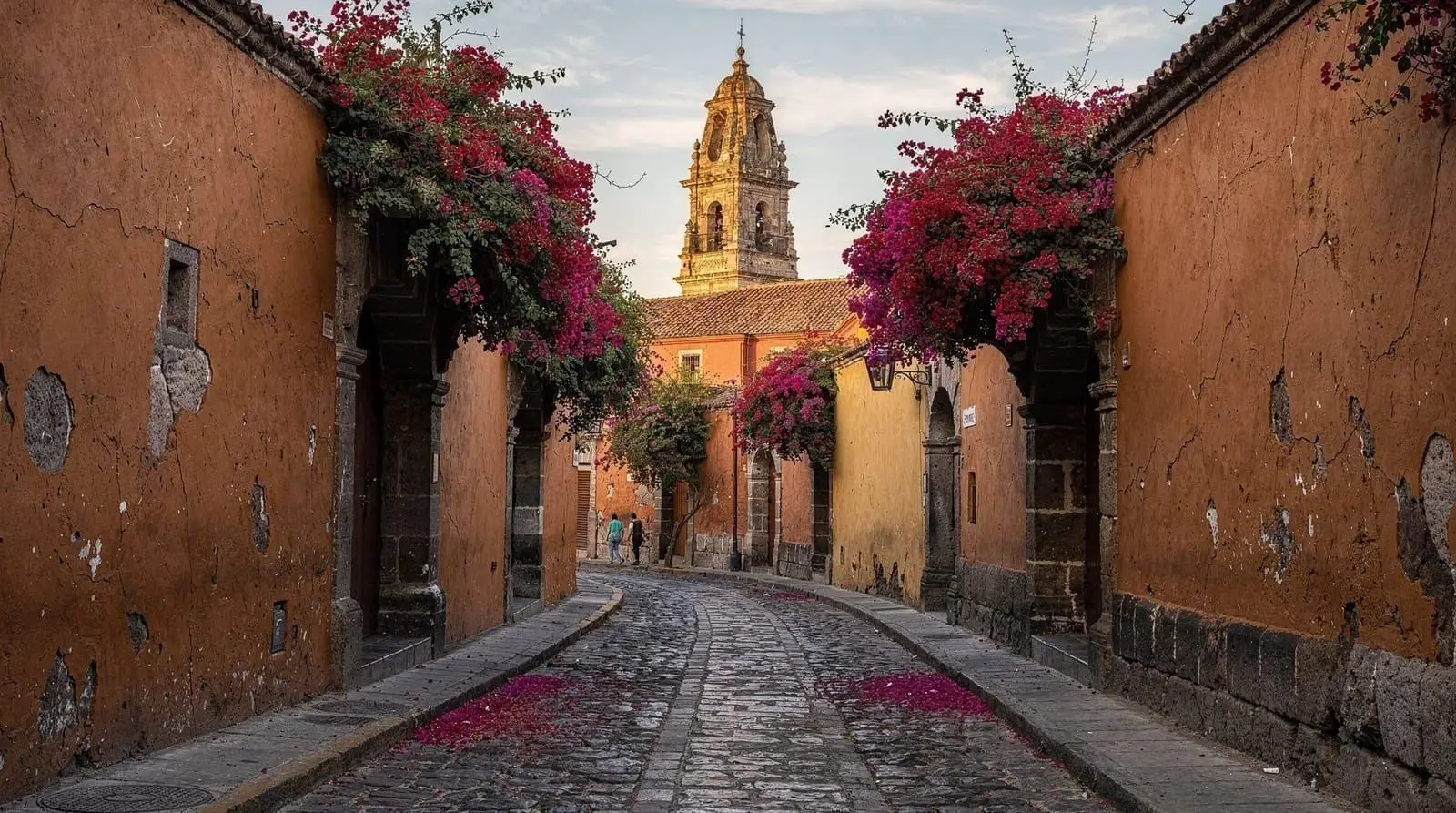
San Ángel
San Ángel: Saturday Bazar del Sábado art market, Carmelite convent, and the Diego Rivera–Frida Kahlo double studio. Colonial Mexico City's quieter south.
Mexico City: Bazaar Saturday, Convent of Carmen & San Angel
Duration: 6 hours
Quick facts
- Altitude
- 2,240 m / 7,350 ft
- Currency
- Mexican peso (MXN) — USD widely accepted
- Best for
- Saturday art market, colonial architecture, Rivera-Kahlo studio house, UNAM campus
- Getting there
- Metro Line 3 to M.A. de Quevedo, then walk or take Metrobús Insurgentes to Dr. Gálvez
A colonial enclave that survived the city’s growth
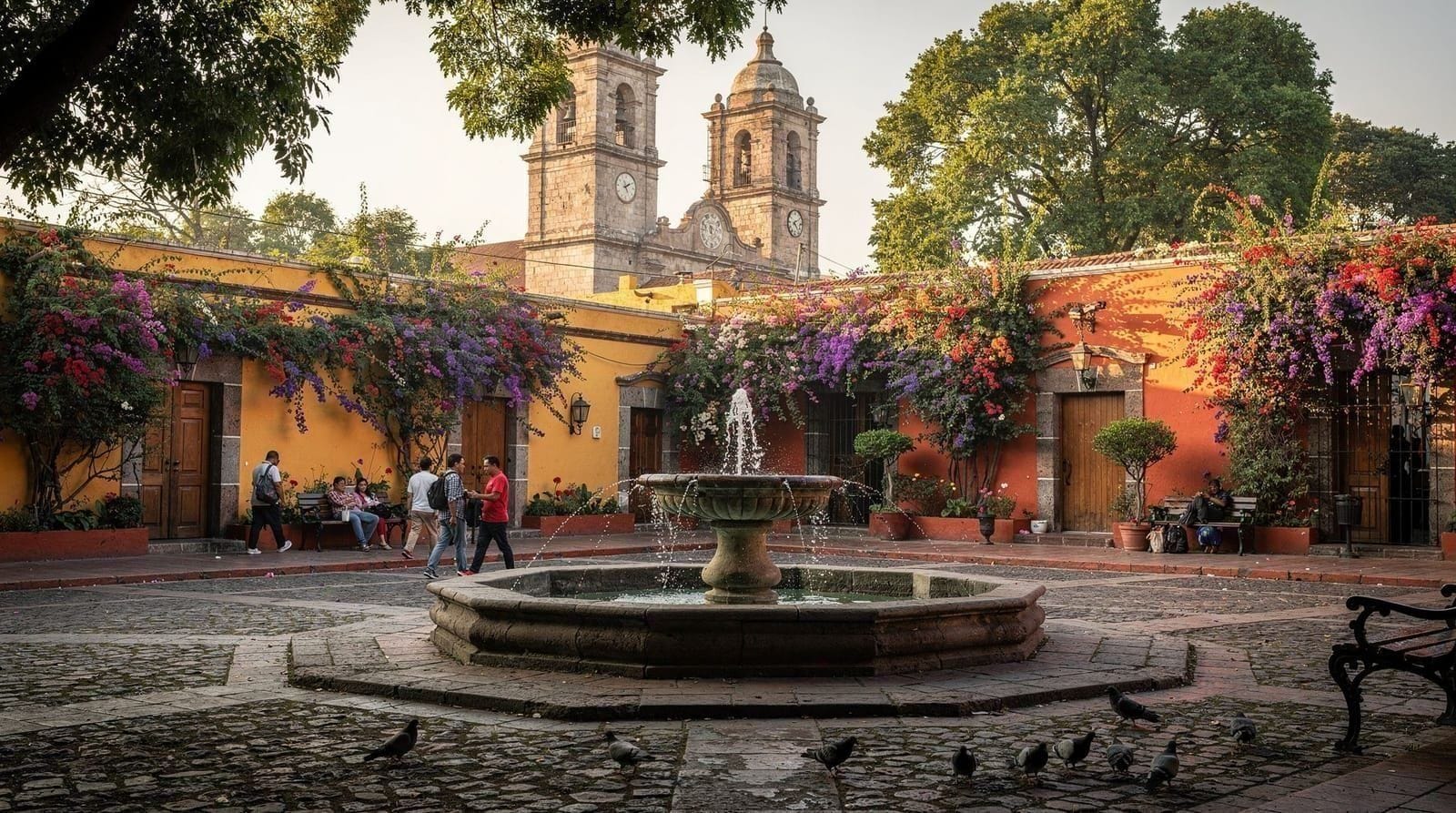
San Ángel is a colonial neighbourhood in the southwest of Mexico City — older in its founding than Coyoacán, quieter than Roma, and almost entirely unknown to international tourists who have not been directed here specifically. It was an independent town until Mexico City absorbed it in the 20th century, and its core still functions as a coherent historic village: cobblestone streets, high walls with painted doors, 16th and 17th-century religious buildings, and a Saturday art market that has been running continuously since 1960.
Most visitors arrive on Saturday specifically for the Bazar del Sábado and spend two to three hours before moving on to Coyoacán, which is about 4 km east. This is a reasonable approach. A weekday visit is less dramatic but allows you to see the Ex-Convento del Carmen and the Museo Casa Estudio Diego Rivera y Frida Kahlo without the weekend crowds, and the neighbourhood’s streets are more pleasant when not filled with Saturday market traffic.
| Where | Southwest CDMX, about 4 km west of Coyoacán |
| Cost | Museums 60–85 MXN each; market pieces from around 500 MXN |
| Time needed | Half day, or a full day combined with Coyoacán |
| Getting there | Metrobús Insurgentes (Line 1) to Dr. Gálvez, then a 10-minute walk |
| Best time | Saturday for the market; weekdays for quieter museums |
Bazar del Sábado: the Saturday art market
The Bazar del Sábado at Plaza San Jacinto 11 has operated every Saturday since 1960, making it one of the longest-running art markets in Latin America. The format is essentially unchanged: artists and artisans with a juried selection process display and sell work in two areas — a covered indoor market in a colonial building around a courtyard, and outdoor stalls around the plaza.
The indoor section is the higher quality of the two. Works range from folk art ceramics and Oaxacan painted wood figures to contemporary painting, silverwork, embroidered textiles, talavera ceramics, and jewellery. Prices are negotiable; the indoor vendors are more experienced at negotiating than the outdoor ones. Budget 500–3,000 MXN for a piece of quality folk art; less for smaller decorative items.
The outdoor plaza section has a wider range of quality — from mass-produced souvenir items to genuinely interesting handmade work. Walking the whole plaza before buying is essential because similar items vary significantly in price between vendors. The market runs 10:00–18:00, with 11:00–14:00 being the peak period for sellers and buyers.
A San Ángel Saturday Bazaar and Ex-Convento del Carmen guided tour includes both the market and the convent with historical context about the neighbourhood’s colonial heritage. The tour runs on Saturdays and is useful for first-time visitors who want to understand what they are looking at in both places.
Ex-Convento del Carmen
The Museo del Carmen at Avenida Revolución 4 occupies a 17th-century Carmelite convent and is one of the best small museums in Mexico City. The building itself — baroque church, cloister gardens, tiled domes — is architecturally outstanding. The museum collection covers colonial religious art, period furniture, and the building’s history. The crypt beneath the church contains eleven naturally mummified bodies from the 19th century, displayed in glass cases, which constitute one of the more surprising encounters in Mexico City’s museum circuit.
The mummies are not presented sensationally — they are displayed with some contextual information about the nuns and friars who lived at the convent — but they are startling if you arrive expecting conventional religious art. Entry is 85 MXN. The building is quiet on weekdays and crowds very modestly even on Saturdays.
Museo Casa Estudio Diego Rivera y Frida Kahlo
The double studio house at Palmas and Altavista, designed by the architect Juan O’Gorman in 1931, was where Diego Rivera and Frida Kahlo lived after their marriage. The two buildings — Rivera’s pink studio tower and Kahlo’s blue studio — are connected by a bridge above the walled cactus garden. Rivera’s studio is preserved with his paintbrushes, pre-Columbian collection, and working spaces. Kahlo’s studio has been more sparsely interpreted but retains the bones of her working environment.
This is not the same experience as the Casa Azul in Coyoacán — there are fewer objects and less narrative density — but for visitors interested in Rivera and Kahlo’s relationship and working practices, it is a useful complement. Entry is 60 MXN and is usually uncrowded. Closed Mondays. The Diego Rivera murals guide covers the full map of Rivera’s work across Mexico City, including the Anahuacalli Museum (which Rivera designed in volcanic stone south of San Ángel).
UNAM campus: 20 minutes south
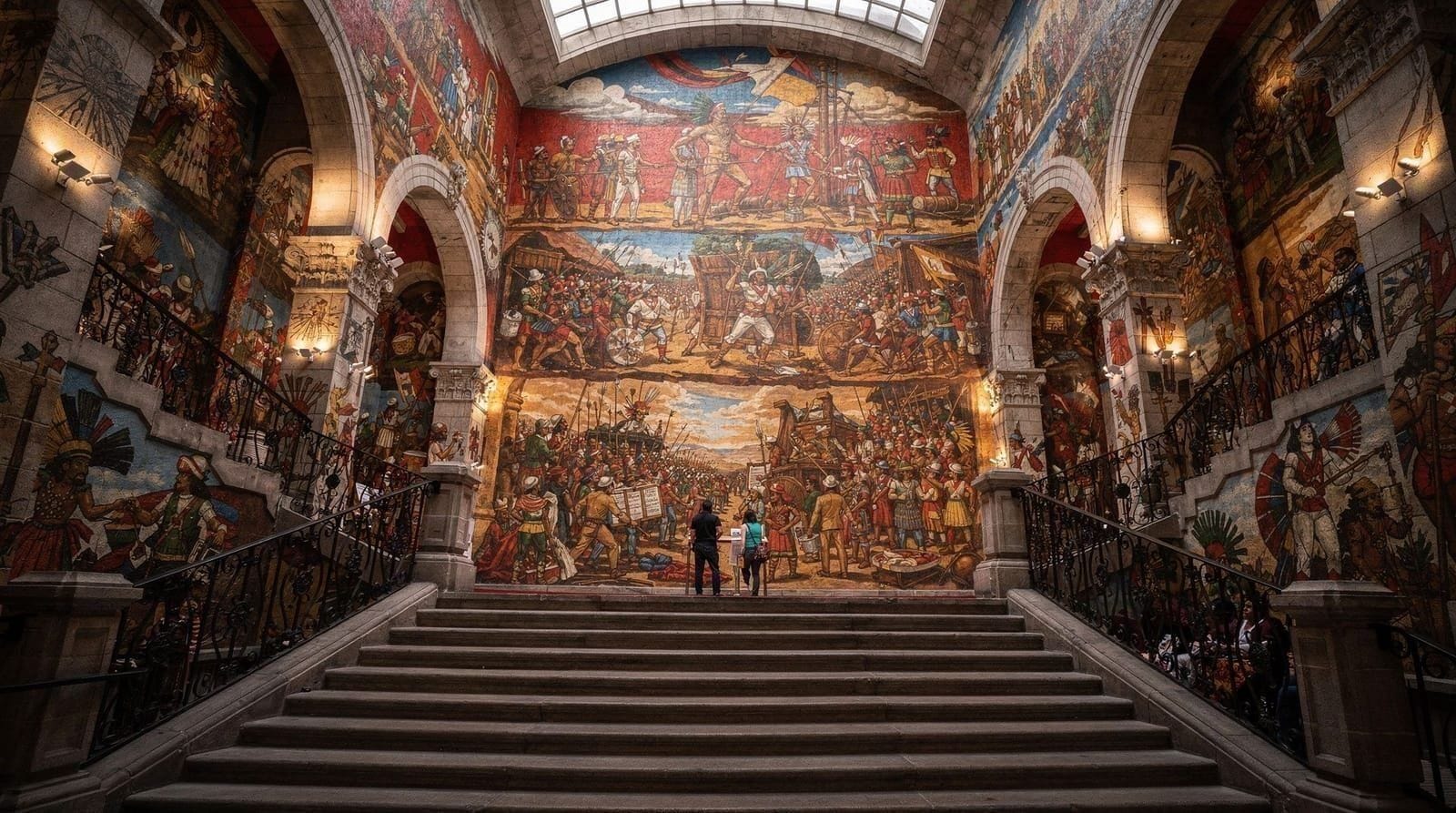
Ciudad Universitaria — the campus of the National Autonomous University of Mexico — is a 10-minute taxi ride south of San Ángel and is itself a UNESCO World Heritage Site (2007). The campus was designed in the early 1950s with major murals by Rivera, Siqueiros, and O’Gorman integrated into the architecture. The main library building has four exterior walls covered in mosaic murals by O’Gorman depicting Mexican history using volcanic stone in natural colours — one of the most ambitious decorative programmes in 20th-century architecture. Entry to the campus is free.
The UNAM campus UNESCO heritage walk covers the key murals and architecture with a guide who explains the political and artistic context that makes the campus murals significant within the Mexican muralism movement.
Eating in San Ángel
San Ángel’s restaurant scene is lower-key than Roma or Condesa but has some genuinely good options. El Bazar del Sábado’s courtyard restaurant inside the market building serves traditional Mexican food during Saturday market hours — it functions largely as a lunch destination for market visitors and is reasonably priced at 180–280 MXN for mains. The atmosphere inside the colonial courtyard is better than the food.
For a more serious meal, Restaurante San Ángel Inn at Diego Rivera 50 occupies a converted 17th-century hacienda with a garden setting and serves upscale traditional Mexican cuisine. Prices are significantly higher (350–600 MXN for mains) but the building and garden are worth it for a leisurely lunch. Lunch reservations recommended on Saturdays.
La Casona on Altavista, near the Diego Rivera–Kahlo studio house, is a café and bakery that works well for breakfast before the Bazar opens. Several casual lunch spots on Insurgentes south of Periférico serve comida corrida (set lunch menus) at 90–130 MXN for three courses — aimed at local workers rather than tourists and priced accordingly.
The Perisur shopping centre at the Periférico junction has a food court and supermarket for practical supplies; it is not the reason to visit San Ángel, but it is useful for visitors who want to pick up water and snacks before heading south to Coyoacán or Xochimilco.
Getting there and practical planning
San Ángel is accessible via the Metrobús Insurgentes line (Line 1) south to the Dr. Gálvez stop, which is a 10-minute walk from Plaza San Jacinto. From Coyoacán, it is a 10-minute taxi or Uber (35–50 MXN). From Roma Norte, Uber takes 20–25 minutes and costs 50–80 MXN.
The neighbourhood is most rewarding when combined with Coyoacán in a single southern Mexico City day — San Ángel in the morning, Coyoacán market lunch, then optional Xochimilco in the afternoon. See the 4-day Mexico City itinerary for how to sequence this.
The Pedregal: volcanic lava field beneath the neighbourhood
San Ángel sits at the northern edge of the Pedregal de San Ángel — a lava flow from the Xitle volcano that erupted approximately 2,000 years ago and covered approximately 80 square kilometres of what is now southern Mexico City. The lava field buried several pre-classic period settlements under 2–3 metres of basalt, some of which have been excavated and are accessible at Cuicuilco Archaeological Zone (7 km south), Mexico City’s oldest archaeological site, with a circular pyramid dating to approximately 600 BCE.
The UNAM campus was built on the Pedregal in the 1950s and the ecological reserve on the campus preserves a section of the original lava field as native scrub habitat. The basalt rock used in the Diego Rivera and Kahlo studio house walls came from this same volcanic substrate. Walking through San Ángel and knowing the neighbourhood rests on a millennia-old lava field adds a geological dimension to what otherwise presents as purely colonial history.
Day of the Dead in San Ángel
San Ángel hosts one of Mexico City’s more atmospheric Día de Muertos events on November 1–2, when the neighbourhood streets are lined with marigold-decorated altars and processions wind through the cobblestone lanes. The event is smaller and more neighbourhood-scaled than the massive Zócalo events or the Xochimilco floating altars, which makes it more intimate. Several local families open their street-facing altars to view, and the main plaza has a community ofrenda. A Day of the Dead experience in San Ángel puts you inside the altar-lined streets and community ofrenda during the two-day event, rather than passing through as an observer. For information on the full Day of the Dead programme across Mexico City, see the Day of the Dead guide.
San Ángel versus the Bazar Sábado alternative markets
If the Bazar del Sábado’s Saturday-only schedule doesn’t fit your trip, San Ángel’s quality of craft is not easily replaced elsewhere in the city, but the Mexico City markets guide covers other market options that run daily, including Mercado de Artesanías La Ciudadela in the centre. Combining a San Ángel Saturday with Xochimilco the same afternoon is a common southern CDMX day for visitors who want market, colonial architecture, and canals in one outing, though it makes for a full day — check the getting around Mexico City guide for realistic transfer times between the three.
San Ángel with children
The Bazar del Sábado is reasonably kid-friendly — the courtyard restaurant and open plaza give children room to move between browsing stops, and the crypt mummies at the Ex-Convento del Carmen are a genuine hit with curious older children (younger ones may find them unsettling). The Mexico City with kids guide has more on pacing a family day around San Ángel and Coyoacán together, and the itinerary length guide helps decide whether San Ángel earns a dedicated half-day on a shorter trip.
Where San Ángel fits in a wider trip
San Ángel works best as one piece of a southern-CDMX day rather than a stand-alone outing. If you are choosing a base, the where to stay guide and the Roma and Condesa page explain why most visitors sleep north and travel south for the day. Pairing the neighbourhood with Coyoacán and the Coyoacán walking guide gives a natural second half to the day.
For a Frida Kahlo angle, the Frida Kahlo Museum guide shows how the Casa Azul compares with the double studio house here. If you are building a short stay around these sights, the 3-day itinerary and the 5-day itinerary show where a southern half day can slot in, while the first-timer mistakes post is worth a read before you go. Check the getting around guide for transport options and the safety guide for general street-smart advice, especially in busy market crowds.
Frequently asked questions about San Ángel
When is the Bazar del Sábado open?
Every Saturday, 10:00–18:00, at Plaza San Jacinto 11. It runs year-round including holidays. The best selection and most animated atmosphere is between 11:00 and 14:00. After 16:00 some vendors start packing up early.
Is San Ángel walkable from Coyoacán?
Not really — they are about 4 km apart, which is walkable in good conditions but requires navigating a stretch of Insurgentes that is not particularly pleasant on foot. Uber or Metrobús between them takes 10–15 minutes and is the practical choice. Both are walkable internally once you arrive.
What makes the Ex-Convento del Carmen museum unusual?
The crypt mummies. A 17th-century Carmelite convent with a naturally mummified collection of 11 individuals — monks, nuns, and others — discovered in the crypt and displayed since the museum opened. It is unexpected, historically legitimate, and one of those things that distinguishes Mexico City’s museums from more conventional offerings.
Can I skip the Perisur mall stop and still restock supplies before Coyoacán or Xochimilco?
Yes — the Perisur food court and supermarket are convenient but not essential. Mercado de Coyoacán, ten minutes further on, has its own supermarket-adjacent stalls and better prepared food if you’d rather wait and buy supplies there instead.
Can I visit San Ángel on a weekday?
Yes, and for the museums (Ex-Convento del Carmen, Casa Estudio Rivera–Kahlo) a weekday is actually better — fewer crowds and more space to move through the rooms. The Saturday market is the main reason to go on a weekend; the colonial streets and museums are less crowded and more atmospheric Tuesday through Friday.
How far is San Ángel from Roma or Condesa?
Approximately 12–15 km south, which translates to 25–35 minutes by Uber (80–120 MXN) depending on traffic. The journey by Metrobús Insurgentes south takes about 35–40 minutes and costs 6 MXN. San Ángel is a deliberate trip, not a quick walk from the main tourist neighbourhoods.
Is San Ángel worth visiting on a short trip?
If you have three days or fewer in Mexico City, San Ángel is one of the first things to cut unless the Saturday market timing aligns with your visit and craft shopping genuinely interests you. On longer trips (four days or more), it earns its place as a quieter counterpoint to Coyoacán’s crowds, especially paired into the same southern-CDMX day.
Top experiences
Bookable activities with verified prices and instant confirmation on GetYourGuide.